
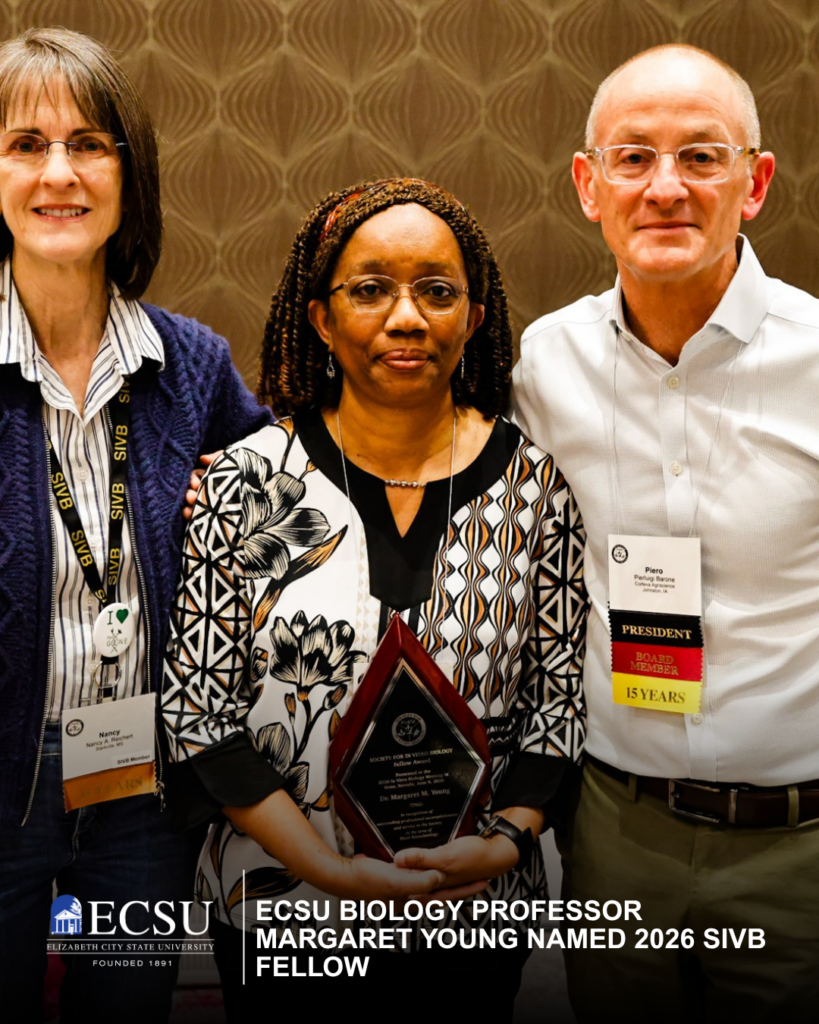
Elizabeth City, N.C. — Nearly three decades of advancing science—and more than two decades of bringing students along the journey—have earned Elizabeth City State University (ECSU) biology professor Margaret Young, Ph.D., one of her field’s most distinguished honors. Young received the 2026 Society for In Vitro Biology (SIVB) Fellow Award during the organization’s annual In Vitro Biology Meeting, recognizing her role in vitro biology, commitment to mentoring undergraduate students, and dedicated service to the Society for In Vitro Biology.
The SIVB established the Fellow Award to recognize outstanding professionals who have made significant contributions to in vitro biology and demonstrated service to the organization. For Young, who has served on the ECSU faculty since 2003, the recognition reflects a career dedicated to connecting scientific discovery with undergraduate research opportunities and student development.
An advocate for undergraduate research, Young became ECSU’s first director of undergraduate research in 2016. In that role, she expanded Undergraduate Research Week, an initiative that continues each spring semester showcasing student researchers across the university.
Her work has focused on advancing plant biotechnology through teaching, research and outreach, intentionally connecting all three to create research experiences for undergraduate students.
Long before the term “course-based undergraduate research experiences,” or CUREs, became widely used, Young incorporated lab experiments and research exercises into courses for ECSU biology majors. The experiences allow students to develop and demonstrate scientific knowledge while building technical, analytical and communication skills for future careers and graduate studies.
Her mentorship extends beyond the classroom.
Young has mentored more than 50 undergraduate researchers in her lab, where students design and conduct plant tissue culture and transformation experiments. Under her guidance, ECSU students made history as the first historically Black college or university (HBCU) researchers in the American Campus Tree Genome Project. Using one of the oldest oak trees on ECSU’s campus as their living laboratory, students collected leaves from the oak tree near the G.R. Little Library. They extracted high-quality, molecular-weight genomic DNA from the tree’s nuclei, mitochondria and chloroplasts. They sent the DNA to HudsonAlpha for sequencing. Once the sequencing was completed, researchers returned the chloroplast data to ECSU, where students used bioinformatics tools to identify genes and annotate the genome before submitting the completed work. This research is now publicly available through the National Center for Biotechnology Information, one of the world’s largest repositories of genetic information.
Young’s work in plant genetics has also connected ECSU and its students to a bigger scientific community focused on advancing the field. She served as an advisory committee member for the National Science Foundation-funded Plant Genetic Engineering Network, or PlantGENE, a community-driven initiative designed to advance global capacity in plant transformation and gene editing through research, training and knowledge sharing. She continues to participate in PlantGENE, promoting training opportunities for students, teachers and scientists.
With Young, ECSU students have also presented 28 posters at national scientific meetings, gaining valuable professional development and exposure to the scientific community.
Her service to the SIVB spans approximately 30 years, beginning when she was a graduate student at Mississippi State University. She has served on the organization’s Education Committee for 20 years, including two years as its elected chair. She is currently the Vice Chair of the Plant Biotechnology section.
Big opportunities often require big investments, and Young has helped bring both to ECSU. She has secured more than $1 million in external funding as principal investigator, primarily from the U.S. Department of Education and the National Science Foundation. Through the SIVB Education Committee, she secured external funding and kits that supported hands-on workshops for students and educators at three In Vitro Biology meetings. She and her undergraduate students have presented their research at 17 In Vitro Biology meetings and World Congresses.
Her commitment to students has also earned recognition on the ECSU campus. Young has received the university’s Student Focus Staff Award, an honor awarded by students, and the Department of Natural Sciences Teacher of the Year award three times. She is also the 2026 ECSU First Runner Up for Teaching Excellence from the Board of Governors, UNC System.
For Young, the work is not centered only on science; at its heart are the students. Her central mission has been to create opportunities for the next generation of scientists to learn, investigate and contribute. Her 2026 SIVB Fellow Award recognizes a distinguished body of work whose greatest measure is the impact it will have on generations to come. Young’s story is featured in Issue 60-3 (July-September 2026) of the Society for In Vitro Biology’s In Vitro Report. To read more about her wide span of contributions and achievements to the field, click here.