
While researching and writing his book on the history of Elizabeth City State University (ECSU), Glen Bowman, Ph.D., uncovered a story he couldn’t leave behind. It was the story of a school that helped educate Black teachers in northeastern North Carolina, launched the careers of influential educators, and helped shape ECSU’s earliest years—yet disappeared more than a century ago amid a movement that sought to dismantle Black educational institutions. That discovery ultimately inspired Bowman to bring the forgotten story back to the community where it began.
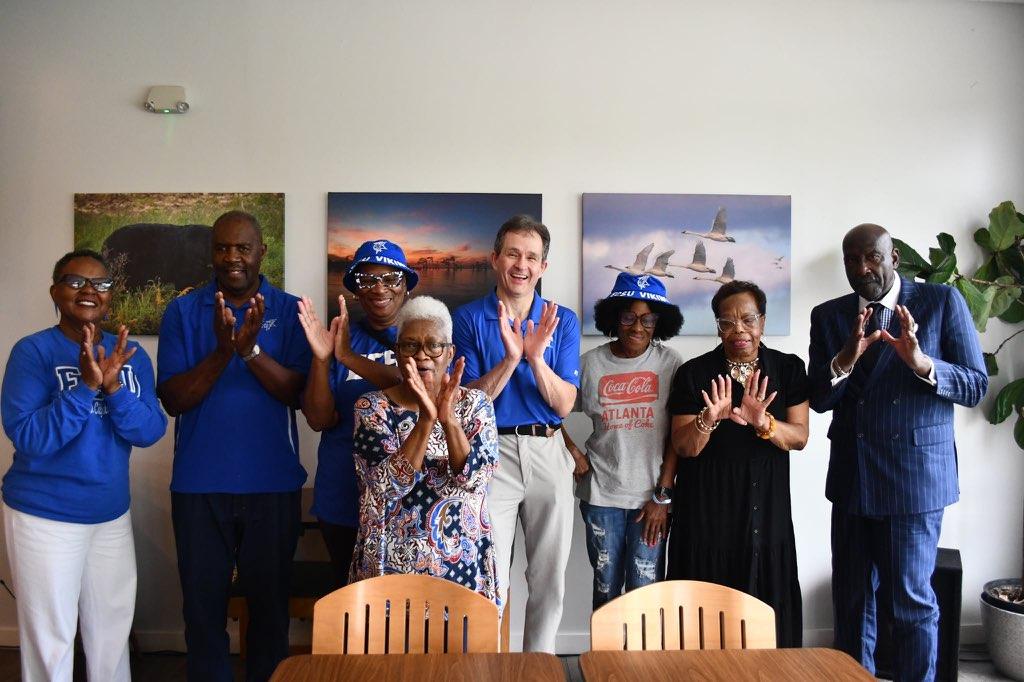
Bowman, professor of history and president of the North Carolina Association of Historians, spoke June 27 in Plymouth about the historical connection between ECSU and the Plymouth State Colored Normal School (1881–1903). His presentation drew ECSU alumni, community members and local media and later became the basis for a feature published by the Roanoke Beacon titled, “Talk explores Plymouth Normal School’s link to ECSU.”
Although Plymouth State Colored Normal School was founded a decade before Elizabeth City State Colored Normal School, Bowman said the two institutions are often misunderstood.
“I learned that although it was founded before Elizabeth City State, it was one of those Black normal schools that were closed down during the early 20th-century consolidation of Black normal schools,” Bowman said. “At one time, there were seven Black public normal schools in North Carolina. Only three survived, and all three are in the CIAA.”
Bowman explained that the closures occurred during the rise of the white supremacy movement that returned the Democratic Party to power in North Carolina and reshaped public education for African Americans. While researching the topic, he also discovered a historical marker in Plymouth that incorrectly identified Plymouth State Colored Normal School as the parent institution of ECSU.
“As a historian, I knew it was in error,” Bowman said. “So when I was invited to give a talk in Plymouth about the history of the school, I eagerly jumped at the opportunity.”
Rather than serving as ECSU’s parent institution, Bowman explained, Plymouth State’s lasting influence is found in the educators whose lives connected the two schools.
The Plymouth State Colored Normal School was the first Black normal school established in northeastern North Carolina and produced educators whose impact extended far beyond the region. Peter Weddick Moore served as assistant principal there before becoming the first principal of Elizabeth City State Colored Normal School in 1891. John Henry Manning Butler, one of Plymouth State’s distinguished graduates, later joined Moore in Elizabeth City before becoming a professor at what is now North Carolina A&T State University and eventually helping develop the educational system of the Philippines.
Another educator, Professor John Doles, came to Elizabeth City after Plymouth State closed and devoted more than four decades to serving Elizabeth City State Normal School and Teachers College. Today, buildings on the ECSU campus bear the names of Moore, Butler and Doles, reflecting a legacy that continues to shape the university.
“I am aware of some current faculty who have roots in Plymouth, so the historical connection still exists,” Bowman said.
For Bowman, seeing Viking alumni fill the audience reinforced the importance of preserving and sharing the university’s history.
“Viking alumni have always faithfully attended my talks on the history of their alma mater,” he said. “I enjoyed seeing their enthusiasm and love for ECSU. They are such an important part of our outreach, and they have brought in over the years a countless number of students because of their infectious support of the school. They are our unpaid (but not unappreciated) ambassadors.”
Bowman said preserving history is about more than documenting the past. It is about helping future generations understand the people and places that made today’s opportunities possible.
“People go through their daily lives having no clue of the history that preceded them,” he said. “We are all a product of those who came before us. As a historian, I see it as one of my tasks to help preserve the history of this university and of this region, so future generations can learn about it.”
He hopes stories like the one connecting Plymouth State Colored Normal School and ECSU will encourage greater appreciation for the rich educational legacy of northeastern North Carolina.
“We have many reasons to be proud about this campus and this community,” Bowman said. “It frustrates me when I see northeastern North Carolina continually being overlooked, as if this region were unimportant. It’s not now, and it wasn’t in 1891. Plymouth State, although closed for over a century, served a critical role in the history of African Americans and in the history of Elizabeth City State.”
Bowman continues to share ECSU’s history beyond the classroom and public presentations as one of the hosts of Legacy 1891, a university podcast produced by WRVS-FM 89.9 and dedicated to preserving and celebrating the institution’s transformational past. Bowman,alongside university archivist Paige Hendrickson and assistant professor of history Latif Tarik, Ph.D., hosts the podcast to inform and educate listeners about the people, events and milestones that have shaped ECSU since its founding in 1891.