
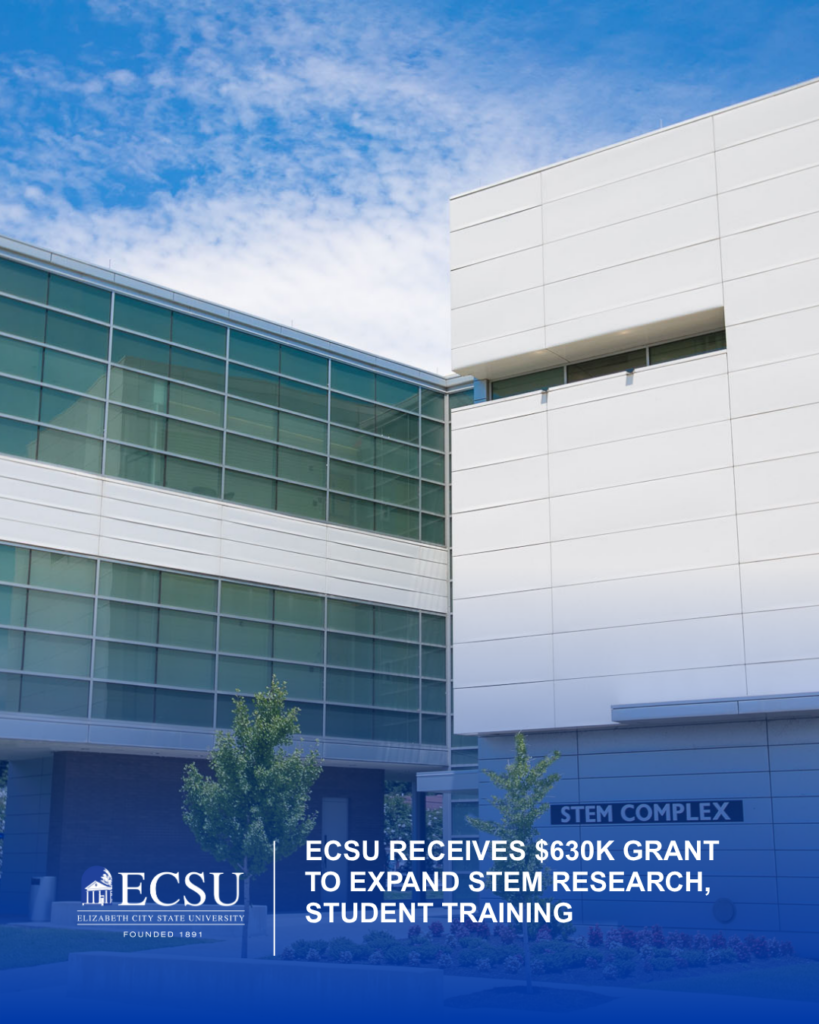
Elizabeth City, N.C. — Elizabeth City State University (ECSU) researchers and students will soon be able to explore the infrared (IR) signature of materials at a scale traditional microscopes and other analytical tools cannot reach, thanks to a $630,000 federal STEM research grant that will bring advanced nanotechnology instrumentation to the university and expand research, student training and STEM outreach across northeastern North Carolina.
“This investment supports ECSU’s continued expansion of research excellence and STEM education,” said Chancellor S. Keith Hargrove, Sr. “It will give our faculty and students access to advanced technology that strengthens discovery, deepens hands-on learning and prepares our students to compete in an increasingly technology-driven economy.”
ECSU received the funding from the U.S. Department of War’s (DoW) Historically Black Colleges and Universities and Minority-serving Institutions (HBCU/MI) Program. Principal investigator Abdennaceur Karoui, Ph.D., principal research scholar and professor of physics and materials science, will lead the project which runs from July 6, 2026, through July 5, 2027.
“This $630,000 investment will position ECSU at the forefront of nanoscale materials research while creating new opportunities for interdisciplinary discovery and collaboration. More importantly, it will place powerful research tools directly in the hands of our students, enabling them to explore, create and develop the expertise and hands-on skills needed to lead in the rapidly evolving fields of science and technology and to compete successfully in the workforce.”
At the center of the project is the acquisition of a NeaSpec nano-FTIR system, an advanced analytical instrument that combines atomic force microscopy with infrared spectroscopy using scanning near-field optical microscopy (SNOM). The technology will allow ECSU researchers to examine the materials’ chemical composition at the atomic and nanometer scale, providing capabilities beyond those available through conventional FTIR or Raman spectroscopy.
That capability has implications across several areas of scientific research.
The instrument will support interconnected multi-disciplinary research projects involving hyperdoped semiconductors, alloyed materials, perovskite photovoltaics, ferroelectric polymers, photocatalysts and antibiofouling coatings. Each requires the ability to characterize materials at the nanoscale and molecular level.
The technology is also expected to strengthen collaboration among disciplines at ECSU, serving as a shared research platform for areas including pharmaceutical sciences, chemistry, engineering technology and biology. Faculty and students can approach complex scientific questions across disciplines while using the same advanced analytical resource.
Access to the technology will provide opportunities for advanced laboratory instruction, mentored research and student-led projects, including honors research. Students can develop technical and critical-thinking skills aligned with graduate STEM programs and careers in research, technology and industry.
The instrument also opens the door to research and instructional experiences that were previously unavailable, allowing faculty and students to conduct nanoscale and molecular-level analysis in real time.
Its reach will extend beyond the university.
ECSU plans to incorporate the technology into K-12 STEM outreach throughout northeastern North Carolina, including summer research internships, laboratory workshops, campus tours and community STEM events. High school students and educators will have opportunities to engage with scientific investigation and advanced research technology, helping expose younger students to potential pathways in science, engineering and technology.
The investment ultimately expands more than ECSU’s laboratory equipment inventory. It increases the university’s capacity to conduct advanced research, train the next generation of scientists, and introduce students throughout the region to scientific possibilities that can begin at the nanoscale and reach far beyond the laboratory.
Funding acknowledgment: The Army Research Office sponsored this research, which was conducted under Grant Number W911NF-26-1-A212. The views and conclusions contained in this document are those of the authors and should not be interpreted as representing the official policies, either expressed or implied, of the Army Research Office or the U.S. Government. The U.S. Government is authorized to reproduce and distribute reprints for Government purposes notwithstanding any copyright notation herein.