
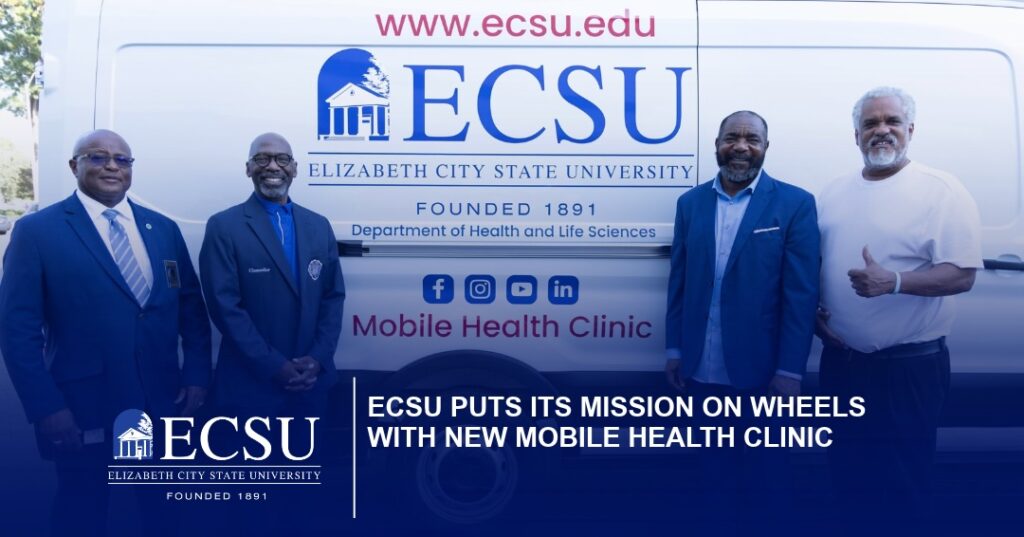
Elizabeth City, N.C. — Elizabeth City State University (ECSU) officially commissioned its new Mobile Health Clinic Oct. 2, putting the university’s longstanding commitment to community service into action and creating a new way to connect health education and resources with communities across northeastern North Carolina.
The commissioning, held at ECSU’s STEM Complex parking lot, brought together ECSU Chancellor S. Keith Hargrove, Sr., Provost Robert N. Corley, Judge Eula Reid and Elizabeth City Mayor Kirk Rivers to celebrate an initiative rooted in the university’s commitment to improving the quality of life for the communities it serves.
Under the leadership of Anthony Emekalam, Pharm.D., RPh, professor of Pharmaceutical Science and the chairperson of the Department of Health and Life Sciences, the mobile clinic will serve as a community-based health promotion and experiential learning platform for ECSU and the 21 rural underserved counties in the university’s service area.
The primary purpose of the mobile clinic is to extend preventive health education and non-invasive community health screening activities into rural and underserved communities while providing structured, supervised experiential-learning opportunities for ECSU students. Activities offered through the mobile clinic will focus primarily on identifying health risks, improving health literacy, encouraging healthy behaviors, connecting individuals with appropriate healthcare and community resources, and helping students understand the social, behavioral, biological, and environmental factors that influence health.
For Chancellor Hargrove, the mobile clinic represents a tangible expression of ECSU’s vision to become more deeply connected to the community around it.
“Often, I say that our goal is to be recognized as a community university. That’s a broad statement, but it really comes down to, ‘what is the role of ECSU in improving the quality of life for the people in this area, in this city, in this part of northeast North Carolina.’ And we are laser-focused on doing just that,” said Hargrove. “We congratulate Dr. Emekalam for his leadership and the many other initiatives you will see over the upcoming years as this university grows in enrollment and academic offerings.”
The mobile clinic gives that commitment a physical presence—one that can move beyond the university’s campus and meet communities where they are.
For Corley, that movement is deeply connected to ECSU’s beginnings.
“One hundred and thirty-five years ago, this institution was born out of a vision for equity and access where our original mandate was to go out into underserved communities and lift others. Today, ECSU, through its School of Business, Health and Applied Sciences and the Department of Health and Life Sciences, is putting that ancestral mission on wheels,” Corley said.
The mobile clinic will support and reinforce academic content in the curricula of many ECSU programs, including Pharmaceutical Science, Kinesiology, Psychology, Social Work, Pre-Nursing, and Biological Sciences.
Its key features and capabilities include a patient consultation table, work surfaces, expansive storage spaces, Wi-Fi and satellite technology, basic health screening devices, and a patient counseling and information dissemination area.
The Van can support the delivery of healthcare-related services such as:
- Blood pressure screenings using automated and/or manual blood pressure equipment
- Height, weight, body mass index assessments
- Non-invasive cardiovascular and wellness risk assessment
- Health-risk and Health-literacy assessments
- Nutrition and healthy-eating education
- Physical-activity and sedentary-behavior assessment
- Wellness and stress-management education
- Basic behavioral-health and psychosocial wellness screenings
- Medication and over-the-counter product education
- Diabetes, cardiovascular disease, hypertension, obesity, and other chronic disease prevention education
- Tobacco and substance-use prevention education
- Distribution of culturally and linguistically appropriate health education materials
- Immunization outreaches
Within its first year, Emekalam hopes to host at least one health promotion event in at least 50-80% of the 21 counties within the University’s service region.
The mobile clinic will be deployed at least once a week. Community members and organizations can request applicable services by contacting the Department of Health and Life Sciences at 252-335-3238.
As ECSU continues to grow its enrollment and academic offerings, the Mobile Health Clinic offers a visible example of what that growth can mean beyond the classroom. For an institution with 135 years of history rooted in access, equity and service, the direction is clear, and ECSU is putting its mission on wheels.