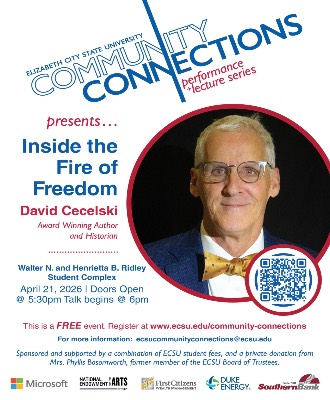
Elizabeth City, N.C. — His name rarely appears in textbooks, yet his actions helped shape the course of the Civil War. Historian David Cecelski is working to change that, bringing the story of Abraham Galloway to the forefront during a public lecture at Elizabeth City State University Tuesday evening.
The event, scheduled for 6 p.m. in the Ridley Student Center, is part of the university’s Community Connections lecture series and is free and open to the public. Cecelski’s talk will draw from his book, “The Fire of Freedom: Abraham Galloway and the Slaves’ Civil War.”
Cecelski said Galloway is a figure often overlooked in traditional accounts of the Civil War, despite his influence.
In an interview with the Daily Advance, Cecelski spoke about his work and his attraction to the story of Galloway. “Galloway is probably the kind of individual that you only discover if you’re the kind of historian I am, or you focus on one place,” Cecelski said. “He turns out to be probably the most important African American leader, unquestionably in the American South during the war.”
Raised on a farm near Beaufort, Cecelski said his early environment shaped his path as a historian.
“I grew up among storytellers in a place where everything seemed to have a memory or a history attached to it,” he said to the newspaper. “Everything seemed to have a story that was both entertaining, but often very important to understand the world I was in.”
That upbringing sparked his interest in the history of Carteret County and, eventually, eastern North Carolina. Cecelski later built a career as an award-winning author and historian and served as a professor at University of North Carolina at Chapel Hill, Duke University and East Carolina University.
His 2012 book, “The Fire of Freedom,” grew out of repeated encounters with Galloway’s name in historical documents.
“I try to find stories throughout eastern North Carolina that open up, maybe, broader lessons about American history,” Cecelski said. “While doing other research on that time period I kept running across these stories of this individual, Abraham Galloway, that I almost had problems believing.”
Among those accounts are Galloway’s role as an early advocate for women’s suffrage and his actions confronting racism, including an incident in which he struck Union soldiers for making racist remarks.
Cecelski said the stories challenged what he learned about slavery and the Civil War.
“[The stories] were so different than what I had been taught about slavery and about the Civil War,” he said.
The lecture begins at 6 p.m. and continues ECSU’s ongoing effort to connect campus and community through accessible, educational programming.