

Aviation Science
Frequently Asked Questions
Aviation Science - On Campus
How do I get a flight lab?
For new students, bring a copy of you Private Pilot Knowledge Test Results to the airport along with your identification and FAA medical. Students interested in flying the first semester will need their FAA knowledge test completed. Otherwise, students will take FLT-110 the first semester with the expectation that they will complete the FAA knowledge test during that first term.
How do I study for the FAA Knowledge Test?
There are a variety of tools to study for the FAA knowledge test. Students can consider King Test Prep, ASA Test Prep, Gleim Test Prep, or many others.
Where do I take the FAA Knowledge Test
If I am not in a flight lab, can I fly ECSU aircraft?
Unfortunately, student enrollment and the demand for flight instructors and aircraft prevent us from offering flight training to students who are not enrolled in the degree program.
Do I need an FAA medical?
Commercial pilots must hold at least a second-class FAA medical certificate to exercise their commercial pilot certificate. Thus, we require our students to show evidence of at least a second-class medical. A first-class medical is suggested, as this is the standard medical for most professional pilots.
You can find an Aviation Medical Examiner by using the FAA’s AME Locator site.
Can I get my Private Pilot Certificate before attending ECSU?
Yes. Students can receive credit for completing their Private Pilot Certificate.
Are there risks to trying to get my Private Pilot Certificate before attending ECSU?
Depending on the flight school you attend, they may not fly the same aircraft type as ECSU. As a result, you will need to spend time adjusting to the new aircraft type.
You may also struggle to get your checkride completed before the start of the term. Many areas of the country have a shortage of examiners. This may delay your certificate significantly.
Is it beneficial to get both my Private Pilot Certificate and Instrument Rating before attending ECSU?
No. Students will need to start and complete the instrument rating at ECSU to be eligible for a Restricted-ATP.
Aviation Science - Online
How does the online program work?
Students can complete academic coursework anywhere with a live internet connection. Flight Labs can be completed with a Flight Training Affiliate (FTA).
Students with their ratings can receive credit for those qualifications and complete the remaining courses as outlined above.
Can I complete additional certificates and ratings while enrolled in the online program?
Yes. Students complete a transient request form to request to complete additional training outside of the online program. Once approved, students can complete additional training at the flight school of their choosing. Financial aid is not available for transient coursework.
How soon can I join a cadet program? Do I go to school while in the cadet program?
We partner with several airlines that offer their own versions of pre-hire programs. Once students meet the eligibility requirements, they can interview with our partner airlines. Successful candidates receive conditional job offers, which become official upon program completion and the accumulation of the required flight hours.
Medical FAQ
What Pre-Flight items do I need take care of?
You must be:
- Must be 17+ years of age
- Obtain a valid FAA Class II Medical (FAA Class I Medical Recommended)
- Proof of U.S. Citizen or Permanent Resident
- Hold a valid U.S. driver’s license
- Proof of high school completion or equivalent
- Pass TSA Background Check
- Pass Drug Screening
What documents do I need to bring?
- Valid U.S. passport and copy of birth certificate (up to date)
- Original birth certificate with raised seal, documenting birth in the United States
- Original U.S. naturalization certificate with raised seal (Form N-550 or Form N-570)
- Original certification of birth abroad (Form FS-545 or Form DS-1350)
- Original certificate of U.S. citizenship (Form N-560 or Form N-561)
Do I need 20/20 vision to fly?
No, but it must be correctable to 20/20 vision. You are permitted to fly with corrective lenses.
Do I need an FAA Medical Certificate?
Yes, in order to begin flight training at ECSU you must obtain a FAA Class II Medical Certificate from a designated Aviation Medical Examiner (AME). Find AME listings on the FAA’s AME Locator.
If I have a color deficiency, can I get an FAA Medical?
Yes, but you must contact the Civil Aerospace Medical Institute (CAMI) office at (405) 954-4821 and request a Signal Light Test. CAMI will set up an appointment for you to visit the nearest FAA Flight Standards District Office (FSDO).
Where can I obtain an FAA Medical Certificate?
Find an FAA Aviation Medical Examiner (AME)
Why should students Elizabeth City State Flight Education Students obtain a FAA Class I Medical Certificate instead of a FAA Class II Medical Certificate?
ECSU’s flight training program is built around one goal: preparing you to become a professional pilot. For most students, that means an airline career, which requires an Airline Transport Pilot (ATP) Certificate — and holding an ATP requires you to meet the medical standards of an FAA First Class Medical Certificate.
A Second-Class Medical Certificate is sufficient for commercial pilot operations such as charter or cargo flying, but it does not meet the standard required to exercise ATP privileges. If you train and build hours under a Second Class Certificate and later discover you cannot medically qualify for a First Class Certificate, you may be unable to pursue an airline career after investing significant time and money in your training.
By requiring a First Class Medical Certificate before you begin flight training, ECSU ensures that any medical issue that could disqualify you from an airline career is identified upfront — before you commit to the program — rather than after you’ve already completed hours and coursework toward that goal.
Bottom line: If your goal is to fly for the airlines, start with a FAA Class Medical Certificate. It’s the same standard you’ll need to hold your ATP Certificate, and confirming you can meet it now protects your time, money, and career path.
Are there height and weight restrictions on students who want to conduct flight training at Elizabeth City State University?
Due to aircraft operational limitations, students taller than 6’3″ or weighing more than 240 lbs. may not be able to operate our training aircraft and, as such, may not be able to successfully complete all flight training at Elizabeth City State University. All students must be able to sit in the aircraft and reach all controls.
Can I fly if I have a history of ADHD?
For individuals who have a history of ADHD or use of ADHD medications*, there are two possible evaluation paths: Fast Track and Standard Track. For information on the different tracks, any required testing, and specific documentation needed, please visit Learn more about ADHD Policies.
Getting Your MedExpress Profile
Before scheduling your FAA Medical Exam Students will have to complete a MedXpress Profile.
Step 1: Navigate to FAA MedXPress and "Request an Account" and fill out information
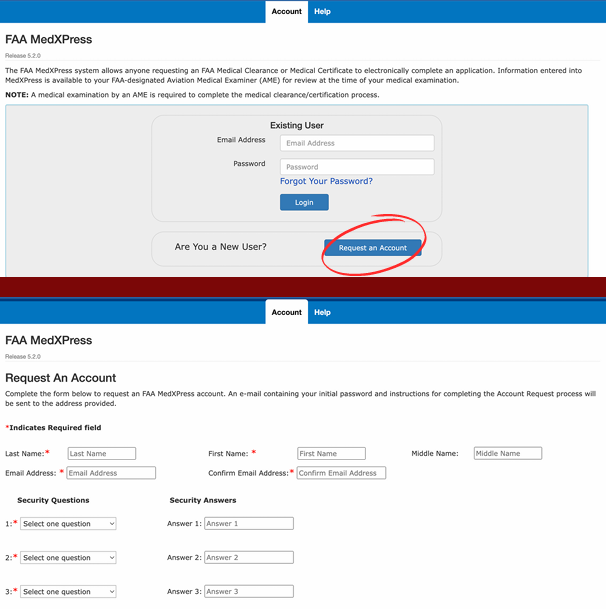
Step 2: Review Privacy Act Statement, check the box and submit. Then "Start New Application"
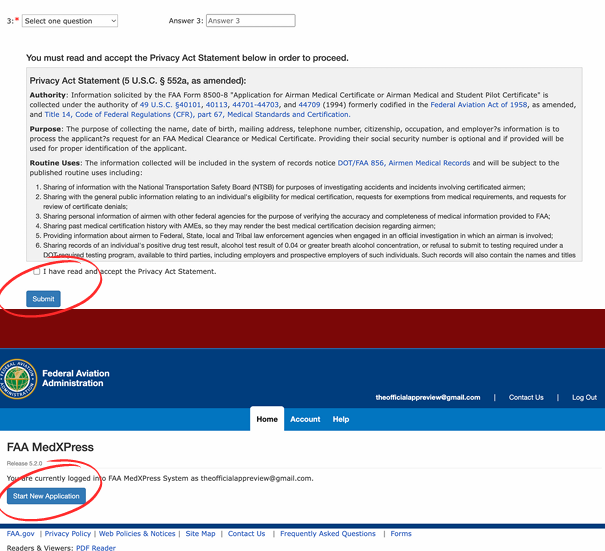
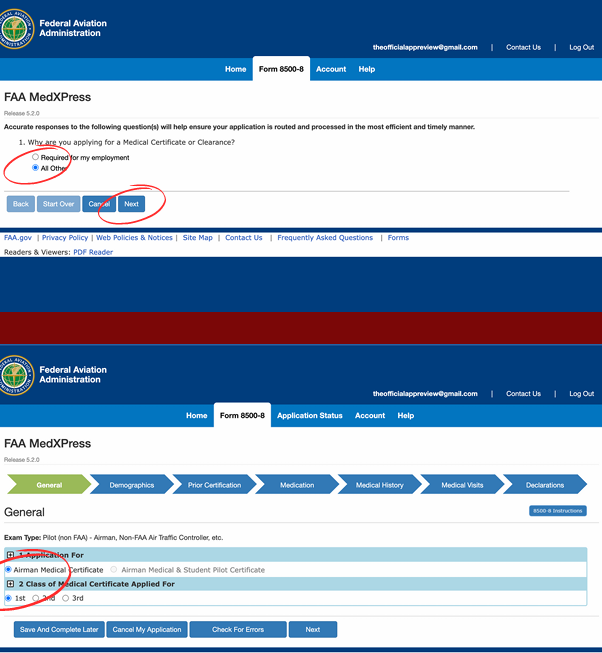
Step 3: Choose the selections indicated in the photo below
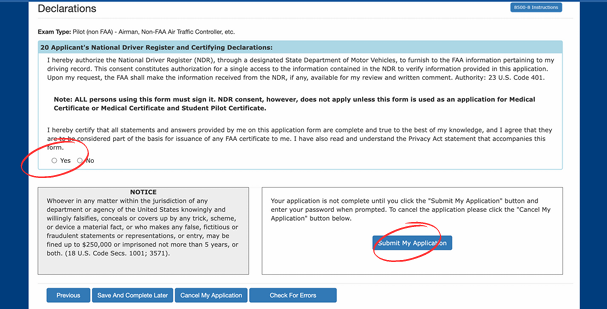
Step 4: Complete the Declarations section and submit application
Step 5: Keep your confirmation number for your appointment
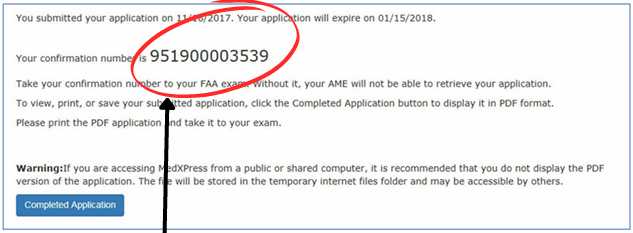
Write this number down and bring with you to your FAA appointment.
More For Aviation
Aviation Leadership
- Mr. Titus Sanders
- Executive Director of Aviation
- STEM Complex, Room 202