
Explore Matter. Understand Science. Apply Knowledge.
Program Overview
The Chemistry minor at Elizabeth City State University provides students with a foundation in the principles and practices of chemistry. This program introduces students to the study of matter, its properties, and the changes it undergoes through a structured sequence of chemistry courses.
Students develop an understanding of core chemical concepts while gaining experience with laboratory techniques and scientific analysis.
Who Should Minor in Chemistry?
This minor pairs well with majors such as:
- Biology
- Pharmaceutical Science
- Mathematics
- Engineering Technology
Students interested in science, research, or health-related careers will benefit from the knowledge and skills developed in this program.
What You’ll Study
The Chemistry minor includes coursework that builds from foundational to more advanced chemistry topics.
Areas of study include:
- General chemistry concepts and laboratory work
- Organic chemistry and chemical reactions
- Advanced or upper-level chemistry coursework
- Scientific analysis and experimental methods
Students develop both theoretical knowledge and practical laboratory skills through hands-on coursework.
Program Structure
The Chemistry minor consists of a sequence of chemistry (CHEM) courses designed to provide a solid foundation in the discipline.
- Includes general chemistry lecture and laboratory courses
- Incorporates organic chemistry or upper-level coursework
- Emphasizes laboratory experience and scientific application
- Designed to be completed alongside a major
At Elizabeth City State University, minors are defined as a group of prescribed and elective courses totaling approximately 18–24 credit hours.
Students should work with an advisor to select appropriate courses and ensure proper sequencing, especially for laboratory requirements.
Career Opportunities
The Chemistry minor develops strong skills in analysis, laboratory techniques, problem-solving, and scientific reasoning, which are valuable across a wide range of careers.
Students may pursue careers in:
- Healthcare and medical fields
- Environmental science and sustainability
- Laboratory and research support roles
- Pharmaceutical or chemical industries
- Education and science outreach
This minor is especially beneficial for students planning to pursue graduate study or professional programs in areas such as medicine, pharmacy, environmental science, or related scientific fields.
Hands-On Learning
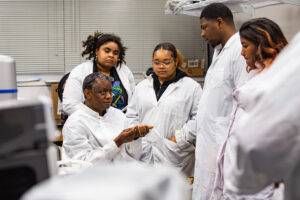
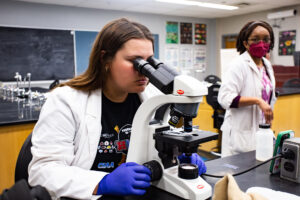
The Chemistry minor emphasizes laboratory-based learning and scientific application.
Students will:
- Conduct experiments using standard laboratory techniques
- Analyze chemical data and interpret results
- Apply scientific methods to solve problems
- Develop skills in observation, measurement, and reporting
These experiences help students connect theoretical concepts to real-world scientific practice.

Interested in adding the Chemistry minor?
Connect with your academic advisor to learn how this program fits into your degree plan.